When Nothing Comes Up: Reading the Silence
Every germinator, from the beginner scattering their first pack of marigolds to the collector coaxing a Cape restio to life, will eventually stare at a tray of quiet, empty soil and wonder what went wrong. The good news is that seed failures are rarely mysterious. Seeds are simple machines governed by water, oxygen, temperature and light. When one of those inputs is off — or when a pathogen sneaks in — the failure leaves clues. This chapter teaches you to read those clues and correct course, ideally before you lose an entire, irreplaceable batch.
A key mindset first: no method germinates every seed. Even fresh, well-stored seed of common species often carries 10–30% that will never sprout, and rare or wild-collected seed can be far lower. Our aim is to eliminate the failures *you* caused, so that the seed's own natural rate can express itself.
Failure 1: No Germination at All
When a tray stays completely bare past the expected window, resist the urge to bin it. First, dig up two or three seeds gently with a toothpick and inspect them. What you find tells you almost everything.
- Seed intact, firm, unchanged — dormancy not broken, or too cold. Many temperate species need cold stratification (e.g. 4 °C for 30–90 days in moist vermiculite) before they will respond to warmth.
- Seed swollen but not sprouting — it imbibed water and stalled. Usually temperature is wrong: check that your medium sits within the species' band, often 18–24 °C for the majority of temperate seeds, 25–30 °C for many tropicals.
- Seed soft, mushy, foul-smelling — it rotted from overwatering, no oxygen, or a fungal attack before the radicle could emerge.
- Seed hollow, papery, crushes to dust — it was non-viable to begin with (empty or dead), which no technique can revive.
Failure 2: Hard-Coated Seeds That Refuse to Imbibe
Species with thick, waxy or stony coats — Canna, Ipomoea, many legumes like Acacia and Lupinus, and Cannaceae generally — are physically waterproof. If a seed has not swollen after 48 hours of soaking, it has physical dormancy and needs help to let water in.
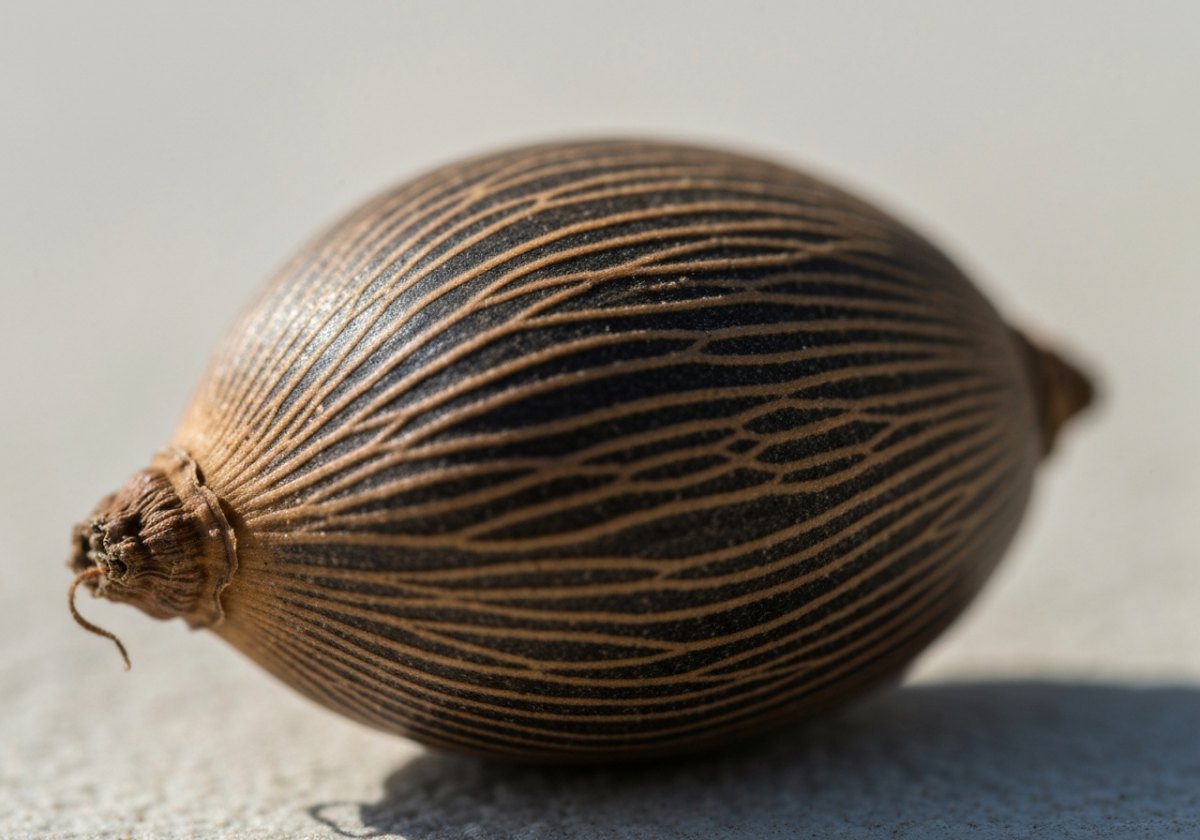
- Scarify: rub the seed on medium (120-grit) sandpaper until you see a small pale patch, or nick the coat opposite the hilum (the scar) with a clean craft knife. Do not cut into the white interior.
- Soak the scarified seed in room-temperature water (about 20–25 °C) for 24 hours. It should visibly swell to 1.5–2× its dry size.
- If it still hasn't swollen, scarify again — you didn't breach the coat the first time.
- Sow immediately at 22–26 °C, 1–2 cm deep for large seeds; a swollen seed left dry can crack and die.
Failure 3: Damping-Off (Seedlings Collapse After Sprouting)
This is the heartbreak scenario: germination succeeds, tiny seedlings appear, then within a day or two they topple with a thin, water-soaked, pinched stem at soil level. This is damping-off, caused by Pythium, Rhizoctonia and Fusarium fungi thriving in wet, stagnant, warm conditions.
- Use fresh, sterile seed-starting mix — never garden soil or reused compost for germination.
- Water from below and let the surface dry slightly between waterings; a permanently glistening surface is a fungal paradise.
- Provide gentle air movement — a small fan on low for a few hours daily lowers humidity at the stem base.
- Keep temperatures moderate: many fungi accelerate above 25 °C in wet conditions.
- Sow thinly. Crowded seedlings stay damp against each other and infect their neighbours instantly.
Failure 4: Weak, Leggy, or Pale Seedlings
If seeds sprout but the seedlings stretch tall, floppy and pale with long gaps between leaves, they are starving for light. On a windowsill in winter, seedlings receive a fraction of what they need. Move them under a simple LED grow light 5–10 cm above the canopy, running 14–16 hours per day. Yellowing after the first true leaves usually signals that the seed's stored reserves are exhausted — begin a quarter-strength balanced fertiliser weekly.
A Quick Diagnostic Table to Keep by Your Trays
- Nothing sprouts + seeds firm → dormancy: stratify or scarify.
- Nothing sprouts + seeds mushy → overwatering/rot: drier mix, better drainage, sterile medium.
- Nothing sprouts + seeds hollow → non-viable seed: not your fault, source fresher stock.
- Sprouts then collapses at base → damping-off: sterile mix, airflow, water from below.
- Sprouts tall and pale → insufficient light: add grow light 14–16 h/day.
- Slow, uneven emergence → temperature too low: raise to species' band, consider a heat mat.
Keep a Germination Log
The single most powerful troubleshooting tool is a notebook. For each sowing, record the species, sow date, medium, temperature, depth, any pre-treatment, and the date the first seedling appeared. After a season, patterns leap off the page — you'll discover, for instance, that your bathroom shelf runs 3 °C cooler than you assumed, or that seeds soaked overnight consistently beat those sown dry. Troubleshooting stops being guesswork and becomes evidence.
A failed sowing that you understand is worth more than a lucky one you cannot repeat.— Quinta dos Ouriques University
Approach each empty tray as a message rather than a defeat. Inspect the seeds, match the symptom to a cause, adjust one variable at a time, and write it down. Do this consistently and your failures will shrink into a small, honest remainder — the seeds that were simply never going to grow, and were never yours to save.