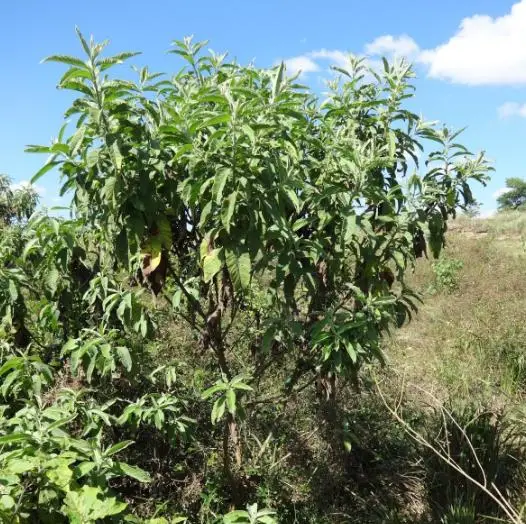
Argania spinosa, commonly known as the argan tree, is a drought-tolerant evergreen endemic to arid and semi-arid regions of southwestern Morocco, Algeria, and adjacent areas. Seeds are encased in a hard tegument that causes physiological dormancy, resulting in naturally slow and inconsistent germination that can take several months. Pre-treatment with mechanical scarification, extended water soaking, cold storage, or gibberellic acid application significantly improves germination rates from 35-60% to 79-95%.
Before sowing
Argan seeds possess physical dormancy with a hard tegument. Mechanical scarification combined with prolonged soaking significantly improves germination. Gibberellic acid treatment or cold storage at 4°C for one month also enhances germination rates. Soaking for 96+ hours or gibberellic acid treatment (2000 ppm) yields germination rates up to 95%
Sowing
What to expect
Tips
Combine mechanical scarification with 96-120 hour soaking at 25-30°C for best results. Alternative: cold storage at 4°C for 1+ months. Gibberellic acid (2000 ppm) is highly effective. Use plastic covers to create a humid microclimate. Germination may begin as early as 12 days but can take 4 months; do not discard pots prematurely. Monitor substrate moisture carefully - keep moist but avoid waterlogging to prevent seed rot and fungal issues. As seedlings develop, gradually remove plastic covering and acclimate over 30 days: provide filtered light for 20 days, then increase to full sun exposure. Reduce watering gradually as plants establish.
Sources: ResearchGate, Annals of Forest Science, academic journals, seed supplier research