The most common question in the garden
If we had a euro for every time a student asked "how long until it sprouts?", we could pave the greenhouse floor in gold. It is the most natural question in the world — you have prepared the substrate, sown the seed, watered gently, and now you wait. And wait. This chapter is about turning that anxious waiting into informed, patient observation. Germination timing is not a fixed number; it is a range shaped by species, temperature, seed age, dormancy, and your own consistency. Let us learn to read those signals.
The honest truth first: germination is never guaranteed, not even for professionals. Seeds are living things with their own history. What we can do is stack the odds in our favour and know what "normal" looks like, so you neither give up too early nor keep watering a pot that will never wake up.
Typical germination windows by seed type
Here are realistic ranges for well-prepared seeds kept at the right temperature. These are typical, not promises — a slow seed is not a failed seed.
- Fast annuals (basil, lettuce, most brassicas, tomato): 4–10 days at 20–25°C.
- Cucurbits and beans (courgette, squash, runner bean): 5–12 days at 22–28°C.
- Peppers and aubergine: 10–21 days at 26–30°C — heat is the deciding factor.
- Mediterranean perennials (lavender, rosemary, thyme): 14–30 days, often erratic.
- Hard-coated seeds (Canna, Ipomoea, many legumes): 3–14 days *after* scarification, but weeks or months without it.
- Cold-requiring woody species (many maples, apples, roses): weeks of cold stratification, then 2–6 weeks of warmth.
- Palms and some tropicals: 1–6 months, sometimes longer, with steady warmth and moisture.
Why temperature is the master switch
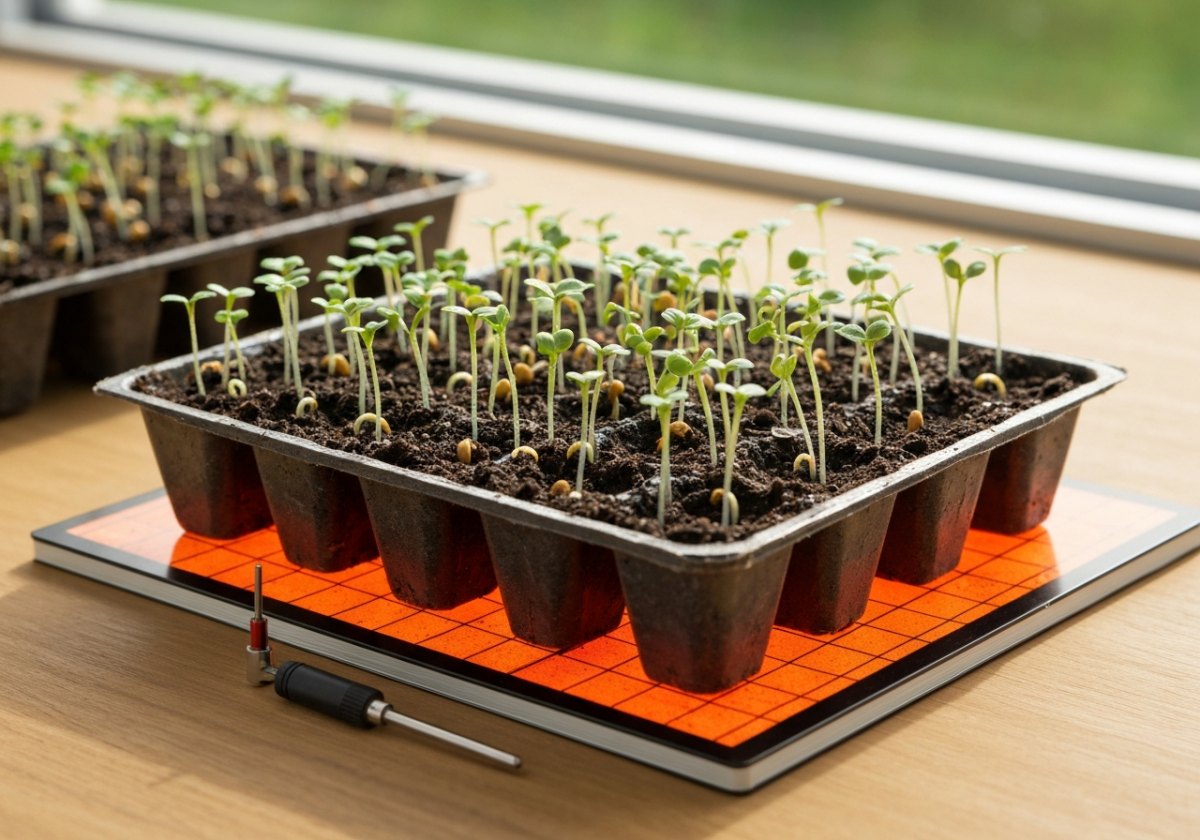
For most seeds, temperature controls speed far more than anything else. Below the species minimum, metabolism nearly halts; near the optimum, enzymes work fastest. A pepper seed at 18°C may take 30 days or rot before it germinates; the same seed at 28°C often shows a root in 7–10 days. A cheap heat mat holding the substrate at 25–28°C is the single most transformative tool for slow, warmth-loving seeds.
Equally, some seeds need *cool* to germinate. Lettuce goes dormant above roughly 28°C (thermo-inhibition), and many alpine or temperate perennials germinate best at 10–15°C. Matching the temperature to the species' native climate is the whole game.
A practical routine while you wait
- Log the sowing date and note the expected window from the ranges above.
- Check daily, briefly. Look for surface heaving, cracked soil, or a pale loop. Do not dig — you will damage fragile radicles.
- Keep the surface evenly moist, never soggy. A fine mist or bottom-watering avoids dislodging seeds sown at 0.3–1 cm depth.
- Maintain the target temperature and check it with a real probe thermometer, not a guess.
- Ventilate covered trays for a few minutes daily to prevent damping-off fungus.
- At the far edge of the window, if nothing has moved, keep going for at least 50% longer before concluding — many species simply run slow.
When 'slow' becomes 'never': reading the signs
There comes a point where waiting is no longer patience but denial. A few honest signals: if the substrate has gone sour-smelling and green with algae, if sown seeds have visibly softened into mush when you gently uncover one at the far end of the tray, or if you have doubled the expected window at the correct temperature with no movement — the batch has likely failed. Common culprits are old seed (viability drops sharply after the recommended storage life), temperatures too low, drying out for even a single day, or burial too deep.
A simple test for stubborn or old seed
When you are unsure whether a seed lot is alive, run a paper-towel viability test before committing a whole tray. Dampen a paper towel, space 10 seeds on it, fold, seal in a labelled zip bag, and keep at the species' optimum temperature. Check every few days. If 6 of 10 show a radicle within the normal window, you have roughly 60% viability and can sow accordingly, thicker to compensate. If none move after double the window, the lot is probably spent — and you have saved yourself a month of false hope.
Closing thoughts
Germination time is a conversation between the seed's biology and the conditions you provide. Learn the typical window, hold the right temperature, keep moisture steady, and label everything. Then let patience do its quiet work. Some of the most rewarding rare seeds are also the slowest — and the day a long-awaited loop finally breaks the surface is worth every day of waiting.
The gardener who counts days learns arithmetic; the gardener who reads the seed learns botany.— Quinta dos Ouriques University